
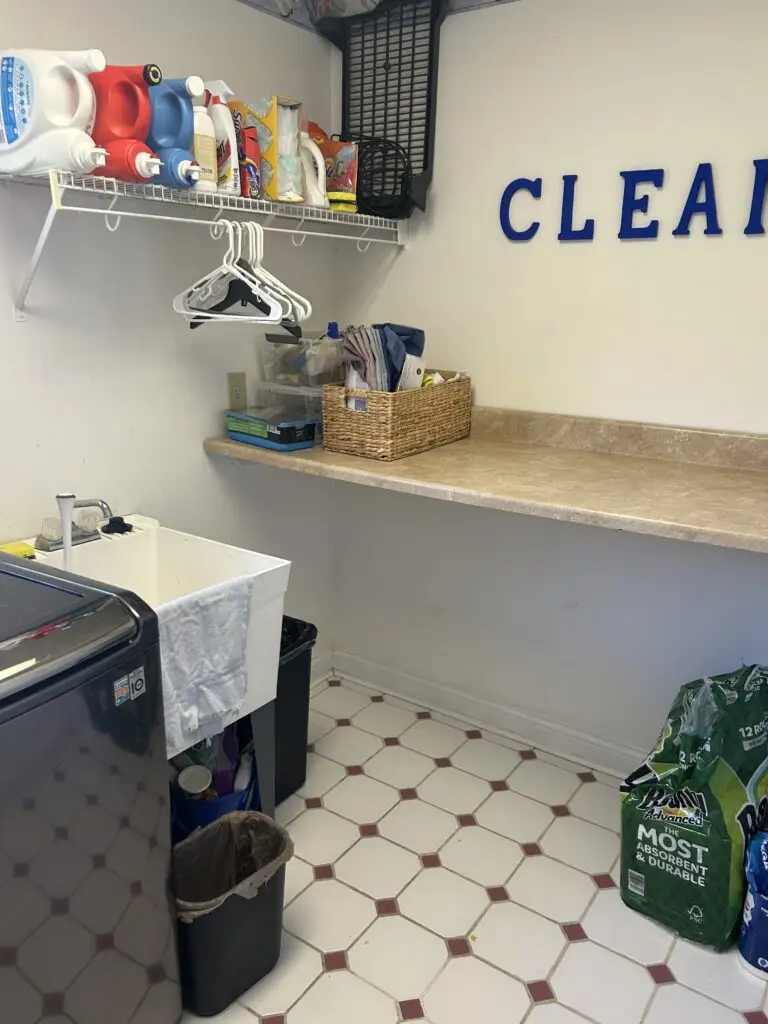
Organizing with ADHD works when the system needs fewer steps than the mess. Most organizing advice assumes you will remember, finish, and put things back behind a door. An ADHD brain does not always do those things, and no amount of trying harder changes that. What changes it is a home set up for how your brain actually works.
Before I was a professional organizer I was a nurse, and I have spent a lot of hours with people who were told their problem was effort. It almost never is. Here is what we do differently for clients with ADHD, and what you can do this week.
Six rules for organizing with ADHD at home
1. If you cannot see it, it does not exist
Closed bins, opaque drawers and high shelves are where ADHD households lose things. Use open bins, clear containers, hooks instead of hangers where you can, and labels on everything. Out of sight is out of mind is not a saying here; it is a design constraint.
2. One step to put away
If putting something away means open a door, pull out a bin, lift a lid and drop it in, it will land on the counter instead. Cut the steps. Open basket by the door for keys and mail. Hook for the coat. A laundry basket with no lid in the room where clothes come off.
3. Store things where you drop them, not where they “should” go
The system should follow your habits. If shoes always come off by the couch, the shoe basket lives by the couch. Fighting a habit takes energy you need for other things; designing around it is free.
4. Fewer things, always
Every item is a decision waiting to happen. Fewer items means fewer decisions, and decision fatigue hits ADHD brains hard. Decluttering is not a nice-to-have here; it is the foundation the rest stands on.
5. Build in a reset, not a standard
Some weeks nothing gets put away. Plan for it. A good ADHD system can be reset in fifteen minutes when a bad week ends, because everything has a visible, obvious home. A system that only works when you are on top of things is not a system.
6. Use a body double
Sorting with someone else in the room is dramatically easier for many people with ADHD. That person does not have to do anything; they just have to be there. This is one of the most useful things we provide, and it is why a session with us gets done what months of solo attempts did not.
Where to start this week
- Pick the surface that frustrates you most and clear it completely. Give it one job.
- Put an open basket at each “landing spot” for the things that always end up there.
- Label three bins. Not ten. Three.
- Set a fifteen-minute timer and stop when it rings, even if you are not done.
Working with us
We build systems around how you live, not around how a magazine says a home should look. For ADHD clients that means visible storage, one-step put-aways, and a reset plan for bad weeks. We do not judge, we do not rush your decisions, and we would rather you did not tidy up before we arrive. If a closet or a kitchen has beaten you three times, it is not you. It is the system.
Rather have us do it with you?
The first visit is free, in your home or over the phone, and you are under no obligation to book anything after it. Book a free assessment, or see real before and after projects across Northern Kentucky and Cincinnati first.