
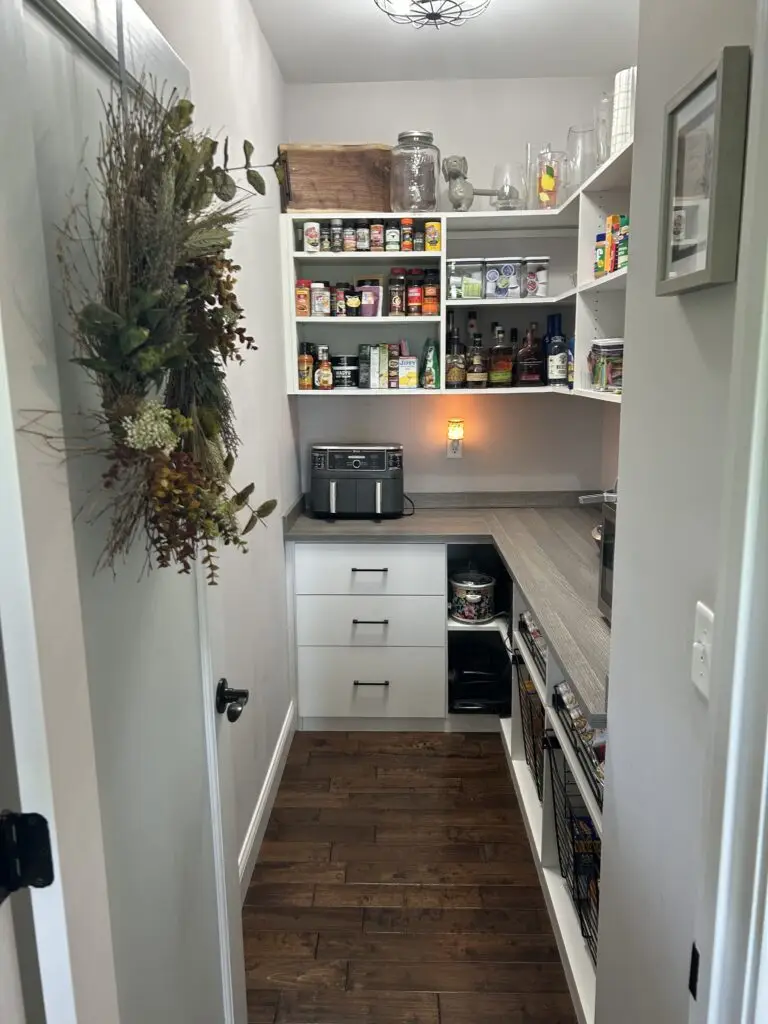
If your house feels like too much, start with one surface you look at every day, and finish it completely. Not the whole room. Not the closet. One counter, one nightstand, one shelf, done to the point where it stays done. That is the whole method, and the reason it works is in how clutter and anxiety feed each other.
Why clutter and anxiety feed each other
Clutter is unfinished business you can see. Every pile is a decision you have not made yet, and your brain keeps a tab open for each one. Research summarized by Psychology Today found that people are less irritable, less distracted, more productive and better able to process information in an uncluttered space. The reverse is also true: a cluttered room keeps the stress response gently switched on all day.
Then the loop closes. The more anxious you feel, the less energy you have for the pile, so the pile grows, so you feel worse. Nobody in that loop is lazy. They are tired, and the room is making them more tired.
Why willpower is the wrong tool
Most people try to fix a whole house with a burst of motivation on a Saturday. By two o’clock the living room is worse than when they started, because everything came out and nothing went back. The burst runs out, the room is half done, and the half-done room becomes proof that it is hopeless.
It is not hopeless. It is a scale problem. A whole house is too big a unit to decide about. A shelf is not.
Where to start: the one-surface rule
- Pick the surface you see most. The kitchen counter you make coffee at. The nightstand. The chair that catches clothes. Choose for frequency, not for size.
- Pull everything off it. All of it, onto the floor or the table. Yes, it looks worse for twenty minutes.
- Purge only the obvious. Trash, expired, broken, duplicate. Do not agonize. Anything that needs a real decision goes in one box marked “later.”
- Plan one job for the surface. The counter is for cooking. The nightstand is for a lamp and a book. If a thing does not serve that job, it does not live there.
- Place what is left, and stop. Do not start the next surface today. Look at the finished one instead. That feeling is the fuel for tomorrow.
This is the same Pull, Purge, Plan, Place method we use on every job, shrunk to a size that fits a bad week.
What to do with the “later” box
Close it and date it. If you have not needed anything in it in a month, most of it can go without being opened. The box does the deciding so you do not have to.
Signs it is time to ask for help
- You avoid rooms in your own home.
- You stop having people over.
- You have started the same room three times.
- Someone you love is going through a hard stretch and the house is making it harder. That is exactly how Urge to Purge started.
Asking is not failure. A second person in the room breaks the loop because they are not tired of the pile, and they are not attached to what is in it. We do not judge, and we mean it: please do not tidy up before we arrive. We need to see how the room really works so the system we build actually holds.
A note from a nurse
I spent years at the bedside and then in chronic-care coaching before I started this business. What I learned there applies here: you do not treat the whole patient in one visit, you find the thing that is causing the most trouble today and you fix that. Then the next thing. A calm home is built the same way, one surface at a time, and it holds because it was built at a pace you could keep.
If clutter is part of a bigger struggle, please also talk to your doctor or a counselor. A clearer room helps. It is not the whole answer, and it does not have to be.
Questions we hear
How long does it take to declutter a whole house?
Room by room, at a pace you can keep, usually several sessions over a few weeks. Doing it fast is how it ends up half done.
Do I have to get rid of my things?
No. Every decision is yours. Our job is to ask good questions, make the sorting faster, and build a home for what you keep.
Do you work with people who feel embarrassed about their home?
Almost everyone we work with feels that way on the first visit and does not by the end of it. We are based in Union, Kentucky and work across Northern Kentucky and Cincinnati. The first visit is free, and it can be a phone call if that is easier.
Not sure where to start?
The first visit is free, in your home or over the phone, and you are under no obligation to book anything after it. Book a free assessment, or see real before and after projects across Northern Kentucky and Cincinnati first.