
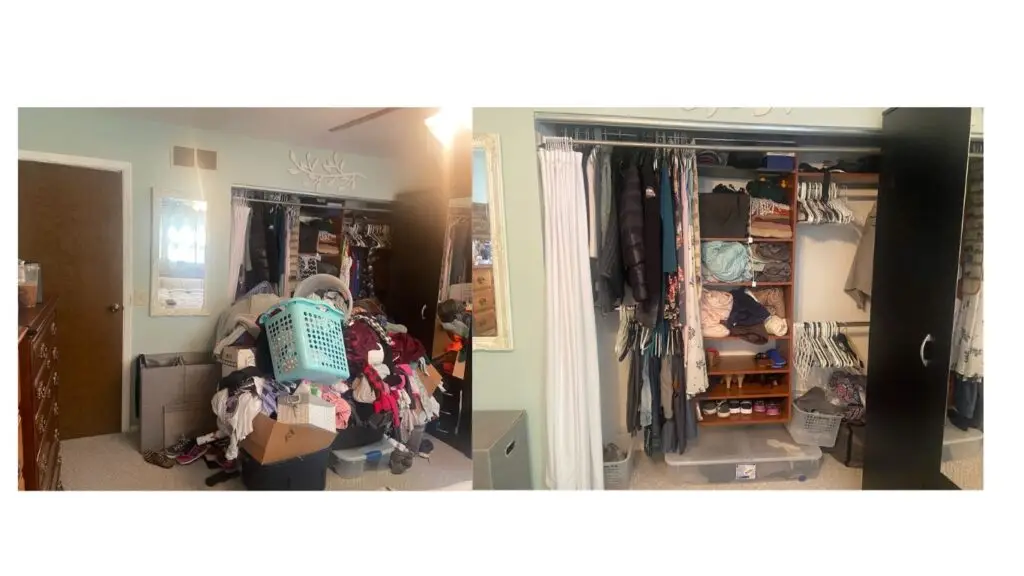
The fastest way to declutter a house before selling it is to pack early, empty the surfaces, and give every room one job. Buyers are not judging your taste. They are trying to picture their own things in the space, and they cannot do that when yours are covering the floor.
We have helped families across Northern Kentucky and Cincinnati get a home ready to list while still living in it, with kids, pets and school mornings in the way. One client sold for $14,000 over asking after we finished. Here is the plan we use.
To declutter a house before selling, start with the rule buyers apply
Buyers open closets, look at counters, and count boxes. A full closet reads as “not enough storage.” A covered counter reads as “small kitchen.” Boxes stacked in a corner read as “this family is halfway out and the house has been neglected.” None of those are true, but they cost you money.
So the target is not “tidy.” It is less. Less on every surface, less in every closet, and nothing on the floor that is not furniture.
Step 1: Sort into three piles, not two
Most decluttering advice says keep or donate. Before a sale you need a third pile: pack for the move. Anything you will not need between now and moving day goes into a labeled box today. Out-of-season clothes, most books, the second set of dishes, the kids’ outgrown keepsakes, the holiday decorations. Packing it now removes it from every photograph and every showing, and you were going to pack it anyway.
Then donate or sell what you do not want to pay to move. With a move coming, that question gets easier to answer.
Step 2: Take the rooms in the order buyers see them
Living room
Nothing stored here. If laundry, toys or paperwork have been living on the sofa, they need a home in another room before anything else happens. Clear the mantel and the coffee table down to a couple of things. In one Cincinnati home we prepared for sale, the living room went from where the laundry lived to a sofa, a fireplace and a carpet, and that photo led the listing.
Kitchen
Counters empty except for one or two appliances you use daily. Pantry one row deep with labels facing out. Fridge front clear.
Primary bedroom
Bed made, nightstands down to a lamp, dresser tops down to a few things. This is the room where buyers slow down.
Closets
Buyers open every one. Aim for a rail with air between the hangers, shoes on a rack, and nothing on the floor. If that means packing half the wardrobe now, pack it.
Kids’ rooms
Keep only what they use, at their height, with the bed as a bed rather than storage. A small labeled bin system means a five-minute reset before a showing instead of an hour.
Garage and basement
This is where the packed boxes go, stacked neatly along one wall. A garage with a clear floor and boxes in a row says “organized move,” not “clutter.”
Step 3: Build a ten-minute reset
A show-ready house is not a house that is always perfect. It is a house that can be made perfect in ten minutes. That only works if every room has less in it and every remaining thing has a home. Laundry has a basket in the bedroom, not the sofa. Mail has one tray. Toys have one bin per room. When the agent calls with a 2 p.m. showing, everyone knows where things go.
Step 4: Decide what you are keeping the house for
You are still living there, so do not strip it to nothing. Keep the things that make the rooms feel warm: a made bed, a plant on the dresser, one framed photo per surface. What goes is the volume, not the life.
A realistic timeline
- Four to six weeks before listing: pack everything you will not need, donate or sell the rest, and clear the garage or basement to receive the boxes.
- Two weeks before: living areas, kitchen, primary bedroom and closets.
- One week before: kids’ rooms, bathrooms, entry. Set up the ten-minute reset.
- Photo day: everything in its home, nothing on the floor, lights on.
With help, most homes take two to four sessions depending on size and how much has to be packed rather than simply organized.
When to get help
If you are staring at the whole house and cannot see where to begin, that is the moment. We declutter and organize for showings, pack what can go early, and can help with the move itself so the boxes we pack now are the boxes we unpack later. The first visit is free, and we work to your listing date.
Questions we hear from sellers
Should I rent a storage unit?
Only if the garage and basement cannot hold the packed boxes neatly. Most homes can. A storage unit adds cost and a second move.
Do I have to declutter if I am hiring a stager?
Yes. Stagers add and arrange; they do not remove your belongings. Decluttering comes first and makes the staging work.
What about the things we cannot decide on?
Box them, label the box “decide later,” and put it with the packed boxes. Deciding is not a listing-day job.
Not sure where to start?
The first visit is free, in your home or over the phone, and you are under no obligation to book anything after it. Book a free assessment, or see real before and after projects across Northern Kentucky and Cincinnati first.